Monday, March 28, 2016

Quote of the Month ~ March 2016


~


Heidi Peterson is a lover of wide-spreading land, summer dust, white pounding waterfalls, and mountain tops; also of good dark coffee and rich stories. Most of all she's a lover of the One who is the Word, the Word made flesh. You can visit her additional blog (where she shares more about books, movies, and further marvels of life) at: Along the Brandywine.

Visit and contact at: Sharing the Journey // Along the Brandywine // ladyofanorien(at)gmail(dot)com

Thursday, March 24, 2016

3 Things I Love in a Good Story // Emma Jane


from Emma Jane


1. Sparkling Dialogue


I’m really not sure why I used the word ‘sparkling’ -- it may or may not be the best choice for what I mean, but it just popped into my head and I thought, why not. ;-P What I really mean is dialogue, and I didn’t want to just say ‘good dialogue’ because that’s boring and I’m pretty sure everyone would say the same thing.

Besides characters, dialogue is probably the most important thing in a story for me -- in fact, it’s what defines the characters. Dialogue is what shows you how the characters think, how they interact with each other. It’s very important that it be realistic and have a natural flow to it; it’s got to sound like how people really talk. One thing that really bothers me about dialogue in a lot of books (mostly adult books, I’ve noticed) is when the characters say things to each other for the sole purpose of informing the reader of what’s going on -- you know they wouldn’t say that to each other, they’re only saying that because the author wants you, the reader, to know. That seems lame to me. If characters talk to each other in an honest, easy way, that really draws me in, and I feel more connected to them. It’s the same with movies.


Some examples of Books With Exceptional Dialogue: True Grit by Charles Portis (DUH DUH DUH); The Lizzie Searches for Love series by Linda Byler (which are pretty much the sweetest books on the planet); Lonesome Dove by Larry McMurtry (or anything by Larry McMurtry, for that matter) 

2. Original description 


I love analogies, and metaphors, and all kinds of yummy descriptions. Admittedly, I’m not a huge fan of extensive description -- I could do without thirty pages about the history of bombs, Mr. Victor Hugo -- but if the author has an insightful way of looking at things and a creative way of describing things, then give it to me, baby! I say ‘original’ because I tend to get annoyed with an author if they keep using a certain word to describe something that I’ve seen countless authors use for the same thing. I love it when authors come up with their own -- it shows great imagination. (Depending on what kind of book it is, I might even go with made-up words, but very rarely. ;-P) 


So yes, I love creative description, but in moderation. I don’t need to know everything; I want to be able to imagine a fair bit of it for myself. 

Some Examples of Books With Refreshing Description: Anne of Green Gables by L.M. Montgomery; the Sarah, Plain and Tall books by Patricia MacLachlan; the Songbird series by Sara Evans and Rachel Hauck 

3. Strong Bonds Between Characters 


I’ve noticed a pattern in books and movies I especially adore, and it usually has something to do with strong relationships between the characters. By this I mean, characters who care about each other, who sacrifice things for each other. This also goes with Strong Characters in General, I suppose. And most of my favorite stories have some kind of strong bond between siblings, between married people, between friends, or even between a crazy trigger-happy grandma and a shy granddaughter. (I love you, Richard Peck.) What’s even more fun is if it’s an unexpected bond, one that grows stronger through the course of the book/movie/whatever. 


Some examples: August King and Annalees in The Journey of August King; Paul McLean and Normal McLean in A River Runs Through It (THAT MOVIE THOUGH); Gus McCrae and Woodrow Call in Lonesome Dove (seriously, don’t get me started); Orry Main and George Hazard in North and South (the most epic friendship ever recorded on screen); Wyatt Earp and Doc Holliday in...well, real life, and Wyatt Earp and Tombstone; Mary Alice and Grandma Dowdal in A Year Down Yonder; Cabot Murray and Eden Day in Yankee Stranger; Anne Shirley and Gilbert Blythe in the Anne books; Atticus Finch and Scout Finch in To Kill a Mockingbird; Simon Birch and Joe what’s-his-name in Simon Birch; and on and on….

(Note from Heidi: Thank you so much for sharing, Emma! :))

~     ~     ~ 

And... would you like to share three of your favorite things in a guest post? You don’t have to be a writer to qualify! This series is by story lovers for story lovers.
For post specifics/guidelines you can see the initial post here, then send Heidi a quick email at ladyofanorien(at)gmail(dot)com. (Don’t be shy. I’d love to have you! :))

Thursday, March 17, 2016

Book Release // Lost Lake House by Elisabeth Grace Foley


Today I'm delighted to be helping out with the celebrations for Elisabeth Foley's latest story Lost Lake House, which just released yesterday! 

A rendition of The Twelve Dancing Princesses (set in the Jazz Age), it's available on Smashwords, Kobo, Nook, and also here on Amazon. I posted a review for it (including the story summary, etc) on my personal/review blog, so be sure to read that HERE. I can't wait to hear your thoughts and hope you're all having a lovely Thursday! 

~     ~     ~

Heidi Peterson is a lover of wide-spreading land, summer dust, white pounding waterfalls, and mountain tops; also of good dark coffee and rich stories. Most of all she's a lover of the One who is the Word, the Word made flesh. You can visit her additional blog (where she shares more about books, movies, and further marvels of life) at: Along the Brandywine.

Visit and contact at: Sharing the Journey // Along the Brandywine // ladyofanorien(at)gmail(dot)com

Friday, March 11, 2016

Inkling Explorations Link-Up // March 2016


(Note: if you're interested in participating and new to the blog, you can find our link-up explanation/guidelines + more buttons here. :))

This month's selection is: A scene involving a letter, package, or post office in film


There are lots of exciting post office scenes out there; many in Lark Rise to Candleford and one in Anne of Green Gables: The Sequel to mention just two sources. And (a tremendous surprise to all of you, I know ;)) my highlighted scene for this month comes from one of my top favorites, the '04 North and South starring Richard Armitage and Daniela Denby-Ashe.

With all the themes of deep truth and loyalty running through the story, this scene, with Margaret mailing the letter to her brother, is pivotal (not to mention gorgeous -- with the dark lines of the street offsetting the white and cream of her dress, shawl, gloves, etc).


(Yes, as one of my top favorite stories and films of all time, I love this movie through and through and through!! ;) You can read my full review HERE.)

Tell me! Have you seen this scene/North & South?


~     ~     ~

Just leave your own link here in a comment and I'll add it to the post. As always, entries are open through the end of the month and I can't wait to see your selections!

Entrants:


*How to do it*


1. Post the Inklings button on your sidebar.
2. Do a post on your own blog relating to the month's selection/subject (a literary excerpt as short or as long as you like AND/OR—if specified that month—a screencap from a film with an explanation of how the scene builds/develops the story). Link back here somewhere in your post.
3. Come back here and paste your link in the comments box and I'll add it to the post. Then enjoy visiting and reading everyone else's contributions!

That's all there is to it!

Up next month: A description of a lady in literature


Monday, February 29, 2016

An Interview with Deborah O'Carroll


Today I'm delighted to be interviewing fellow author and blogger Deborah O'Carroll!


Deborah O'Carroll is a whimsical young writer who loves fantasy, fairytales, anything by J. R. R. Tolkien or Diana Wynne Jones, Celtic music, chocolate, and lists. As an avid lover of words, her favorite pastimes are reading others' tales (and reviewing or proofreading them), penning her own, blogging, and other wordy pursuits. You can usually find her typing away, curled up reading a good book, or endlessly rearranging her “library.” She writes mostly fantasy of different types, has finished three novels, a novella, and several short stories, and is currently exploring the road toward publication (and a long and winding road it is...).

~     ~     ~

1. (Heidi) Some differences and similarities you see between the three major forms of storytelling—literature, music, and film? 
(Deborah) Hmm... Well, film is extremely visual, it's all what you see (and hear), right there, and doesn't leave much to the imagination, whereas literature can delve into a lot of things you can't show exactly, like actual thoughts... And music you hear it, or play it, and it makes you feel, somehow... and it's kind of a mix between both because it does leave a lot to the imagination, but it's also like film in that you hear it. They're all similar in that they tell a story and immerse you in it, but in totally different ways. If you tried to tell the same story in each of the three modes, it would come out totally different, and different people likely lean toward different ones, depending. I think of film as seeing, music as feeling, and literature as imagining. 


2. How have you seen those three mesh together in your own creative process? 
They all tend to get my brain working on ideas that eventually end up in the stories I write. Books that I love make me realize things that I enjoy and would therefore enjoy writing—like when I discovered I like fairytale retellings, and certain character archetypes, and that sort of thing. I don't know if it counts as being related to film, but sometimes having a model of a face for a character can help as inspiration, so sometimes seeing a movie with that actor can help with thinking of facial expressions etc. Music is extremely inspiring for my writing process, whether for setting a mood or inspiring certain individual scenes, and I often listen to music while I write. 

3. When and how did you first begin writing? 
Pretty much since I could hold a pencil? I've been writing since I was a wee young thing, but got serious about it nearly a decade ago (okay, I was still a wee young thing, but slightly older...). As an avid reader and lover of stories from a very young age, beginning to tell stories of my own was a natural progression, and encouraged due to my homeschooling background. I dabbled with a few little tales but they fell by the wayside... 


Then a random young woman and I fell to talking about stories one time (I think I was like ten or something... I sadly remember nothing about her and don't know who she was), and she said she had once started a story about fairies and was sorry she never finished it; so she told me to go pull out the story I'd started, to not give up, and no matter what, to finish it. So with that encouragement, I started it up again. 

A couple years later, when I was at Barnes & Noble, surrounded by real books and wrestling with a pencil and printed pages of the humble few chapters I had written, trying to mark all the things to change, I decided to restart it and that I was going to finish it and be a writer. So I did, and I am. It took me a year and a half, but I finished that novel, and a few years/manuscripts later, I'm utterly enchanted by the world of writing and wouldn't leave it for anything. 


4. What are you currently working on? 
In varying stages (first draft, edits, plotting, reworking, etc.), I'm currently working on: a retelling of The Twelve Dancing Princesses; a Contemporary Fantasy adventure sequel; a book that defies description but I'm currently calling a whimsical world-hopping novel, titled The Other Half of Everything (it's my preciousss right now. *vague Gollum sounds from the background*); and sporadically attempting to rework an entire Epic Fantasy series, which I've had in the works since that first story that I finished. There are many other projects on the back-burner (including a particularly scrumptious Steampunk-fantasy retelling of The Little Mermaid that I keep trying not to start because it's not quite developed enough), but those are the main ones vying for my attention at the moment. The unfortunate consequence of this is that I'm not focused on JUST ONE... which means I'm rather stuck at the moment and need to pick one project to focus on. 

5. Particular author/s who have influenced you? 
Lloyd Alexander. Diana Wynne Jones. J. R. R. Tolkien. Mirriam Neal. George MacDonald. C. S. Lewis. 

6. Is there a “non-writing” activity that shapes your writing? 
Either nothing or everything. Mostly reading, admittedly... but many things that happen in life tend to inform or impact my writing in some way. There's no better “research” than life and great books! 


7. Your opinion on the advantages and disadvantages of digital books? 
Oh boy, this could be a whole post of its own... There are actually a whole lot of disadvantages and advantages both. I personally lean toward physical books, but here are just a few of my thoughts on each side: 

Disadvantages of digital books: They're not REAL. You can't actually HOLD them, or put them on your shelf, or smell them, or pile them in stacks, or rearrange them. If you decide you don't want your ebook anymore, you can't give it away to someone! There's a greater risk of pirating. They can be deleted, which is freaky in itself. They can be edited easier, which means there can be endless editions/changes by the author, which means they're not solid—they can change; which disturbs me, because it gets rid of the finalness of a printed book. It feels like almost a waste of money when one does buy an ebook, since it's just... an e-file. You can lose your place in the book easier when you're reading it. I tend to forget ebooks I've read much easier than physical books. You don't have to turn on real books. Ebooks are not as accessible or portable as real books (I know, people have e-readers. But those have to be charged and things too. It's not as simple). They have no character. 


Advantages of digital books: You can search for things. You can copy-paste lovely quotes instead of typing them up. You can highlight sections or make notes, without committing the great book-crime of mauling a book by writing in it! They are a great way for review/ARC readers to read the books without it costing the author/publisher. They can be cheaper to buy if they're sold for less because there's no printing cost, so the reader can directly benefit (they can also be offered free for a time which can bring in more readers). It can be handy that they don't take up actual square footage when you're running out of shelf space... (When they find me next week buried under the books that have taken over my room, I may be thinking about that last advantage...) 

8. Do you ever do graphic design to help with your writing? 
Yes! Making up mock “covers” and banners and things for my different tales can be extremely motivational and inspiring! (Or at least, that's what I tell myself to convince myself it's not just procrastinating. ;)) 


9. Do you outline? If so, in a general way or very detailed? 
It depends. I usually outline, at least roughly, though I have at times just winged it. Both of them are entirely different modes of writing, and I enjoy different things about both. But mostly I'm an outliner, and while it isn't always extremely detailed, at times it can be, and I do tend to do better when I have the story laid out... even if it changes along the way, as it often does! 

10. Do you work on multiple projects at once? 
Unfortunately, I do. I have too many ideas to focus on only one at a time, which means that I don't seem to make as much headway because my brain is always scattered between a handful of different tales. But I also kind of love it... There are so many stories to be told! The plotbunnies multiply in droves in my neck of the woods, apparently... 

11. Do you edit as you write? 
Yes, always. The one exception is during NaNoWriMo, when I do not allow myself to edit – that time is only for writing, because it's difficult enough to write 50,000 words in a month without having to edit them! But other than November, I always do some editing as I write... It's just the way I'm wired. I like to keep things somewhat tidy as I go along. 


12. Certain themes you see surfacing and resurfacing in your work? 
I haven't a clue. I'm not very good at analyzing my own works. (Perhaps just generic “good vs. evil,” love, friendship, and characters' abilities to change and stuff. Maybe?) I should ask my readers this question... 

13. A particular aspect of writing you struggle with or a challenge you’ve overcome? 
I struggle with fear. It's normally disguised in various lesser forms, but it's usually fear at the base. Fear of starting a story, fear of someone not liking what I write, fear of getting it wrong, fear of not knowing what to write next, fear of committing words to a page because what if they're not perfect? My main struggle with writing is the actually-sitting-down-and-writing part, and I think it mostly boils down to being afraid. (Well, that and a bad case of perfectionist-procrastination. But both of those things are kind of related to fear, so...) I'm working on wrestling with this one. If I could overcome it that would be a great leap. 


14. How do you deal with feedback—particularly negative feedback? 
Feedback of a good sort makes me glow inside and encourages me to press onward even in the darkness. How do I deal with negative feedback? I don't. XD No, actually I don't have a lot of experience with dealing with negative feedback... I'm not very good at it, let's put it that way. Negative feedback depresses me and confirms inner doubts, and in general makes me shut down, even when I know I should distance myself better... I haven't apparently mastered the art of dealing with feedback very well. 

15. One thing you’ve learned from other writers? 
That it's okay to have your own process and figure things out yourself, because everyone does things differently. So as far as advice and others' processes go, take what works for you and don't be afraid to experiment and try new things! 

16. A helpful nonfiction book or website? 
“Eats, Shoots & Leaves” by Lynn Truss is a helpful and funny book on punctuation and grammar, etc., which I highly recommend to any writer. 


17. What do you consider one of the single most important things to remember (i.e. an attitude or technique)? 
I think we need to remember our love and enjoyment of the stories we have to tell. We writers can sometimes take ourselves too seriously, I think, and get too focused on the “craft” and trying to do it all just exactly right... or trying to hit a deadline or a particular wordcount. Sometimes the love and sheer thrill and excitement of creating stories (or as Tolkien would say, “subcreating”) can get lost behind the dusty drabness of “I should be...” (At least for me.) So I think it's important to rediscover and cling to the reasons why we write—whatever that is for you. 

18. A word of encouragement for fellow writers? 
Well... mostly my answer to number 17 above... But also, keep writing. Don't stop. I know you've heard it before, but as that lady told me once, don't give up. Words are powerful, and stories matter. You're the only one who can write the tales you have to tell—so tell them. Keep writing!

~     ~     ~

Note from Heidi: Thank you so much for sharing, Deborah! :)
And everyone, be sure to check out Deborah's blog at: The Road of a Writer.

Saturday, February 27, 2016

The Process for Bringing Resist to Audio // Guest post by Emily Ann Putzke

Today (in conjunction with the release of her new novel this week), Emily's sharing a fascinating post on how she brought Resist to audio. Feel free to interact in the comments then follow the links through to read more about her new book; and also be sure to enter her giveaway!

~     ~     ~

Hello fellow authors! I’m Emily Ann Putzke, author of Resist, a WWII historical fiction based on the true story of Hans and Sophie Scholl. I’m so grateful to Heidi for allowing me to guest post on her blog! I’m here to talk about the process of bringing my book to audio.

1.jpg

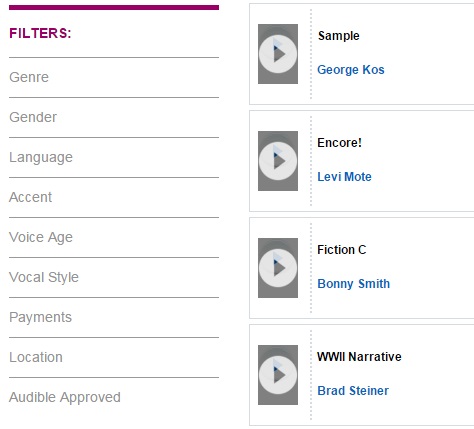
Back in December, I listed my novel on ACX.com, an Amazon platform that connects authors with narrators. From there you can either ask a narrator to audition, or wait until they come to you. I sought out a narrators who would best fit my book by narrowing down the search: accent, age, tone of voice, etc. 

2.jpg

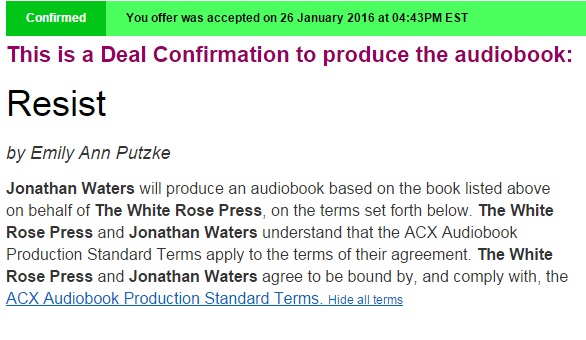
Then I asked them if they’d be interested in auditioning for Resist. Jonathan Waters was one of the narrators I contacted and I really enjoyed his audition. He seemed like a good fit for my book. We agreed on a royalty share, then I made him an official offer.

6.jpg

But before he could produce the entire thing, ACX requires the producer to upload a 15 minute sample of the audiobook to be approved by the author. It’s really a great thing because it ensures that both the author and narrator are on the same page before the entire book is produced.

4.jpg


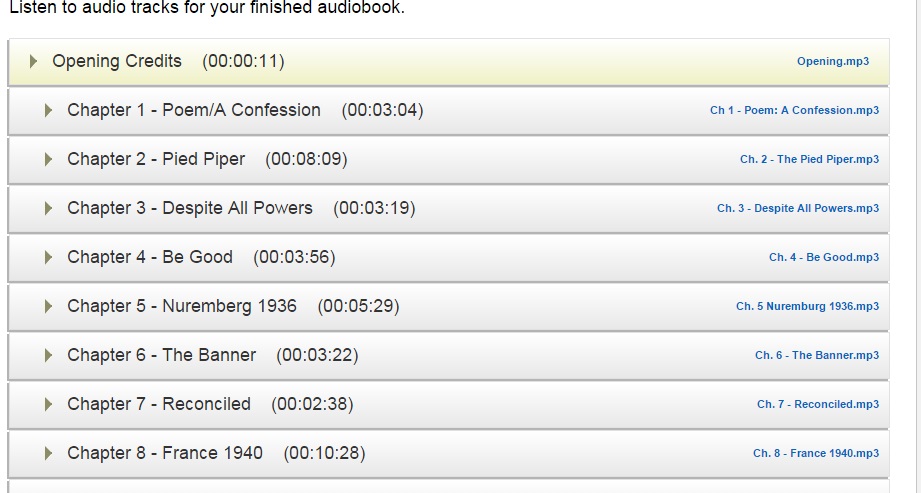
Once I approved the 15 minutes, he set to work producing the audiobook. Then I listened to each track, marked down spots that needed editing, and he quickly fixed them.

 
7.jpg

In an interview with my narrator, I asked him to share his side of things.

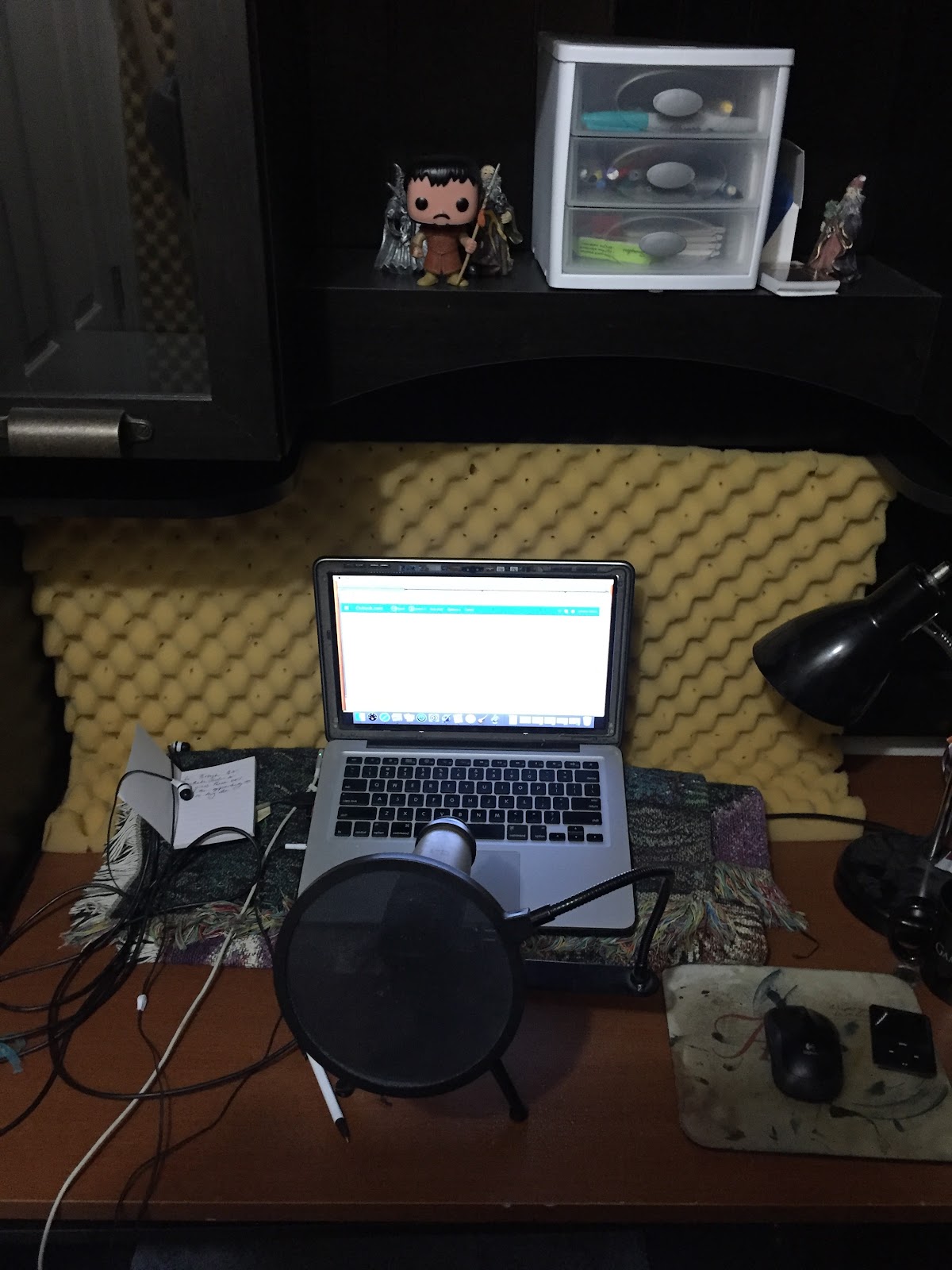
Jonathan Waters: I use a C-1u mic I picked up on eBay for about 60 bucks … I have a small desk stand and a pop screen … I use my mac laptop but would love to 1- get a better one and 2 - dual screen it. To kill some of the sound I have some old memory foam, egg crate, kind of stuff that I stole from my parents. The kind of things that you would put on your mattress to make it more comfortable. It helps. I've put one on my wall behind me. I'm also doing this all from my apartment's walk in closet so I also have some clothing that deadens the sound. Also - I use Skull Candy headphones that I paid about 12 bucks for pretty much anywhere. They, for my sake, get me the best sound when I'm speaking and hearing my voice. 


2016-02-15 16.56.26.jpg

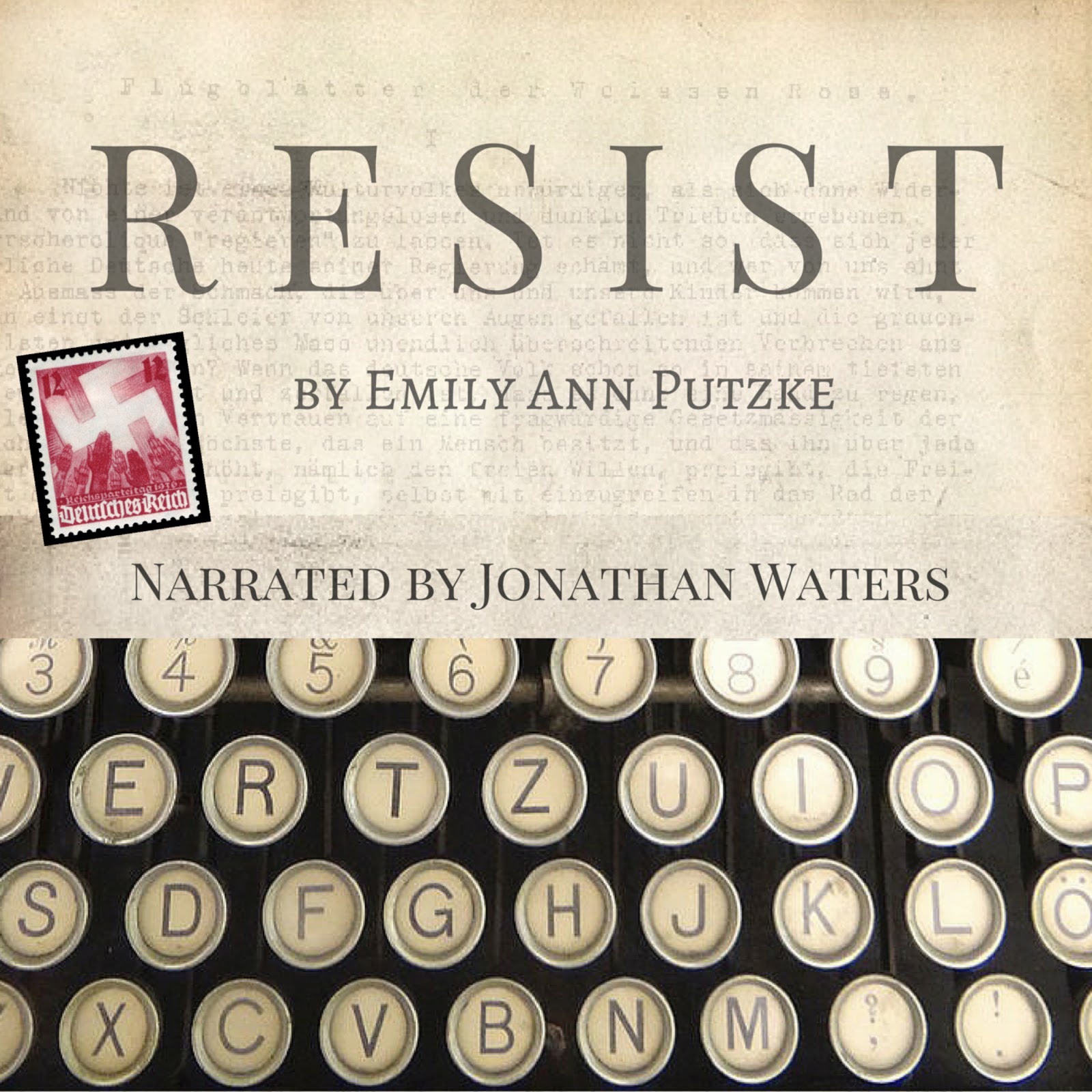
I then had to make cover art for the audiobook, submit the audio for review, and wait for ACX to approve everything. Hopefully by the time this is posted the audio will be available on Amazon and Audible. If not, you have only a few days to wait until it is!

audiobook.jpg

Resist Audiobook Excerpt:


Giveaway:


a Rafflecopter giveaway
Emily Ann Putzke is a young novelist, historical reenactor, and history lover. You can learn more about Emily and her books at authoremilyannputzke.com, facebook.com/authoremilyannputzke, and instagram.com/historicalhappenings 

~     ~     ~

Note from Heidi: Thanks so much for sharing, Emily -- this was great!

Heidi Peterson is a lover of wide-spreading land, summer dust, white pounding waterfalls, and mountain tops; also of good dark coffee and rich stories. Most of all she's a lover of the One who is the Word, the Word made flesh. You can visit her additional blog (where she shares more about books, movies, and further marvels of life) at: Along the Brandywine.

Visit and contact at: Sharing the Journey // Along the Brandywine // ladyofanorien(at)gmail(dot)com

Monday, February 22, 2016

New Book from author Emily Ann Putzke

Today I'm honored to be helping with the launch party for Emily Ann Putzke's new novel Resist! I haven't read it yet, but the premise is definitely intriguing.


Here's the summary:

Munich, Germany 1942—Hans Scholl never intended to get his younger sister involved in an underground resistance. When Sophie Scholl finds out, she insists on joining Hans and his close friends in writing and distributing anti-Nazi leaflets entitled, The White Rose. The young university students call out to the German people, begging them to not allow their consciences to become dormant, but to resist their tyrannical leader and corrupt government. Hans knows the consequences for their actions—execution for committing high treason—but firm in his convictions, he’s prepared to lose his life for a righteous cause. Based on a true story, Hans, Sophie and all the members of The White Rose resistance group will forever inspire and challenge us to do what is right in the midst of overwhelming evil. 


About the Author:
Emily Ann Putzke is a young novelist, historical reenactor, and history lover. You can learn more about Emily and her books on her blog, Facebook, and Instagram.

She's hosting a giveaway, which you can enter here:

a Rafflecopter giveaway
Also, stay tuned as Emily's sharing an exciting guest post here later in the week!

~     ~     ~

Heidi Peterson is a lover of wide-spreading land, summer dust, white pounding waterfalls, and mountain tops; also of good dark coffee and rich stories. Most of all she's a lover of the One who is the Word, the Word made flesh. You can visit her additional blog (where she shares more about books, movies, and further marvels of life) at: Along the Brandywine.

Visit and contact at: Sharing the Journey // Along the Brandywine // ladyofanorien(at)gmail(dot)com
Related Posts Plugin for WordPress, Blogger...